The best nail desk lamp is not simply the brightest lamp that fits on a manicure table. Professional nail lighting should provide clear coverage across the working area, accurate-looking color, controllable brightness and a structure that can be positioned without taking over the workstation.
For salon owners and B2B buyers, the decision also depends on how the lamp will be used. A wide-area lamp, adjustable task light and precision-focused lamp solve different problems. Before comparing individual models, it is therefore useful to define the manicure workstation first.
This guide explains the main factors to compare when choosing a professional nail desk lamp for salon use, wholesale sourcing or a beauty-equipment product range.
What Should a Professional Nail Desk Lamp Do?
A manicure workstation combines detailed visual work with limited desk space. During shaping, cuticle work, polish application and nail art, the technician needs to see a relatively small area clearly while keeping tools and products within reach.
A useful professional nail lamp should therefore balance several requirements:
- clear illumination across the manicure working area;
- minimal distracting shadows from hands and tools;
- appropriate color rendering;
- adjustable brightness or color temperature where required;
- stable positioning;
- enough clearance for normal hand movement;
- a base or mounting system that fits the desk layout.
These factors should be evaluated together. A lamp with impressive specifications can still be inconvenient if it blocks the technician’s working area or cannot be positioned where the light is actually needed.
1. Start With the Manicure Workstation, Not the Lamp
Before comparing products, measure and understand the workstation where the lamp will be used.
Consider the manicure table width and depth, technician seating position, client hand position, location of the nail drill and dust collector, storage areas and any equipment already occupying the desktop.
For multi-station salons, repeatability matters as well. A lamp that works comfortably on one large demonstration table may not fit a row of smaller commercial manicure desks.
B2B buyers should therefore define at least four things before selecting a model:
- available desktop or floor space;
- required working clearance;
- where the lamp can be mounted or placed;
- how far the light needs to reach.
This simple step makes later specification comparisons much more meaningful.
2. Compare Light Coverage Before Maximum Brightness
Brightness is easy to put on a specification sheet, but coverage is often more important in actual manicure work.
A professional nail technician does not work at a single fixed point. The client’s hands move, tools enter the illuminated area and the technician changes viewing angles throughout the service.
If the light source is too narrow, one part of the working area may appear bright while another falls into shadow. A wider lighting structure can illuminate more of the manicure zone at once, while a smaller task light may require more frequent repositioning.
When testing a lamp, do not look directly at the LEDs to judge brightness. Position it at the intended working distance and observe the manicure area instead.
Check whether both hands can be illuminated comfortably, whether shadows appear when the technician reaches for tools, and whether brightness remains reasonably even across the area that matters.
3. Understand CRI and Color Temperature
CRI and color temperature are related to light quality, but they describe different characteristics.
CRI, or Color Rendering Index, describes how accurately colors appear under a light source compared with a reference. For nail work, color rendering can matter when technicians evaluate polish shades, gel colors and detailed artwork.
Color temperature, measured in Kelvin, describes whether white light appears warmer or cooler. Adjustable color temperature can be useful when a salon needs to adapt the workstation to changing ambient light or different working preferences.
Neither number should be treated as a complete measure of lamp quality. Coverage, glare, positioning and the surrounding room lighting still affect what the technician actually sees.
For a more detailed explanation, see LIEQI’s guide to CRI and color temperature for nail salon lighting.
4. Decide Between Wide-Area and Precision Lighting
Not every manicure task requires exactly the same lighting pattern.
General manicure work benefits from broad illumination that keeps the overall hand and working surface clearly visible. Fine nail art, edge inspection and small decorative work can benefit from more concentrated illumination on a specific area.
This creates three common approaches.
Wide-Area Lighting
Wide or curved lamp heads distribute light across a larger part of the manicure workstation. They can reduce the need for constant repositioning and are useful when the technician wants consistent general illumination across the desk.
Focused Task Lighting
A smaller or more directional light concentrates illumination on a limited area. This can be useful for detailed work, provided the lamp remains easy to reposition.
Combined Wide and Precision Lighting
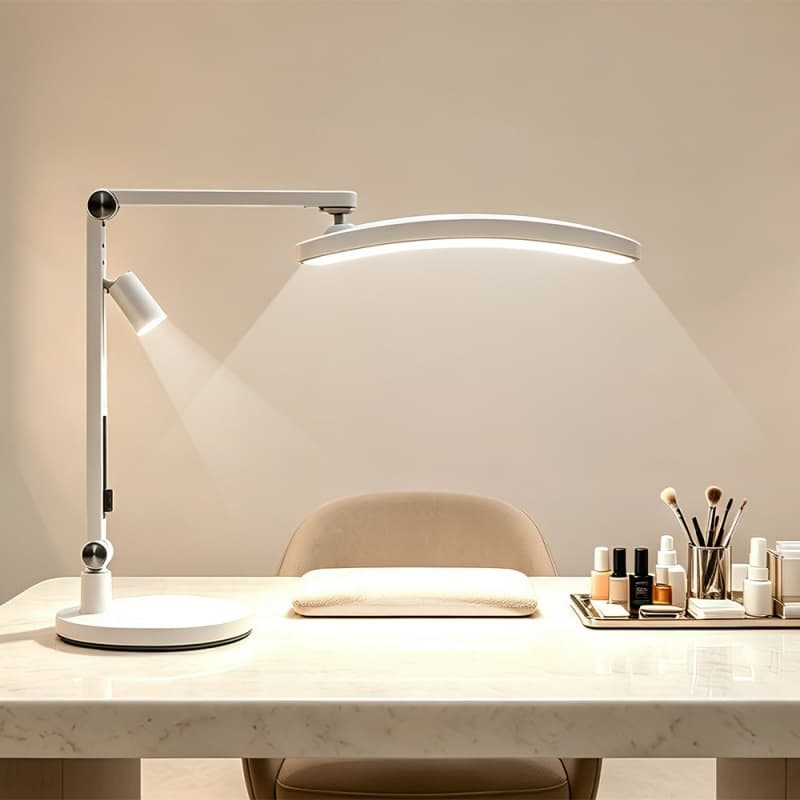
Some newer workstation designs combine broad general illumination with a separate focused source. This allows the technician to use the main light for the overall manicure area and direct additional light toward nail edges, detailed artwork or inspection tasks when needed.
For example, LIEQI’s dual-light nail desk lamp F-697 uses a curved main light together with an independently adjustable spotlight. The important purchasing principle is not the specific model itself, but whether multiple lighting zones solve a real requirement in the target workstation.
5. Check Adjustment Range and Stability
A lamp should stay where the technician positions it.
Adjustment features can include rotating heads, articulated arms, adjustable height and multiple joints. More joints do not automatically mean a better lamp; the useful question is whether the structure reaches the required position while remaining stable.
During sample testing, move the lamp through the same positions a technician would use during an appointment. Check whether joints drift, whether adjustment requires excessive force and whether the lamp can be repositioned without disturbing the client or nearby tools.
For a multi-station salon or wholesale program, repeat this test several times rather than evaluating only the first adjustment.
6. Choose the Right Mounting Structure
The mounting system affects both desk space and positioning.
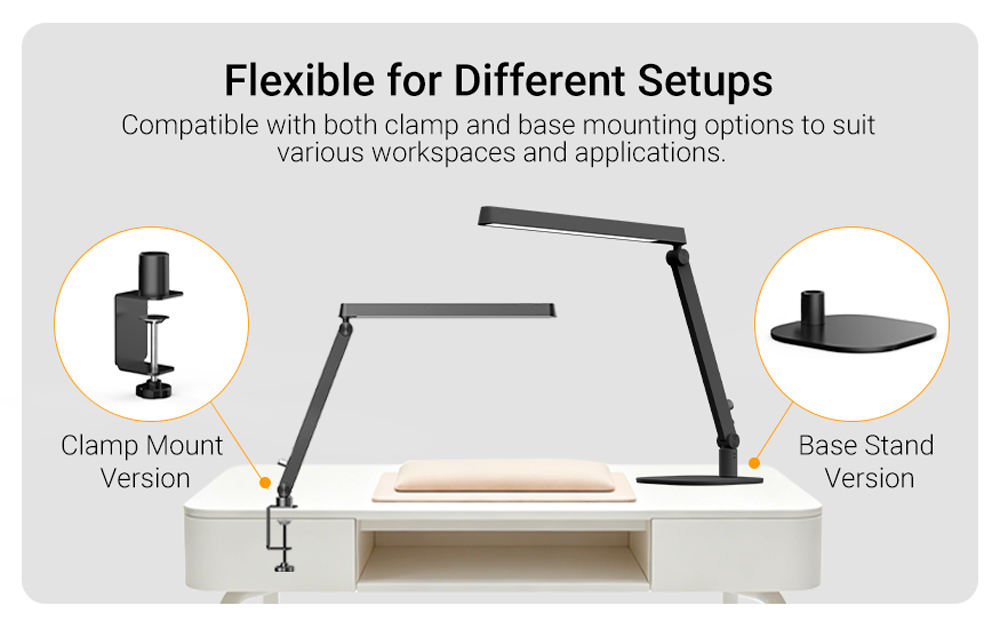
Desktop Base
A freestanding base makes installation straightforward and does not require a compatible table edge. However, it occupies desktop space, so buyers should compare the base footprint with the actual manicure table.
Desk Clamp
A clamp can free up working space by mounting the lamp at the edge of the table. Buyers should confirm the maximum supported desk thickness, the strength of the mounting surface and whether the lamp remains stable when fully extended.
Floor or Independent Structure
Some wider beauty lights use a floor-standing or independent structure rather than mounting directly to the manicure table. This can preserve desk space but introduces different considerations around floor footprint and movement.
There is no universally superior mounting method. The right structure depends on the workstation.
7. Consider Glare and Visual Comfort
Nail technicians may work under the same lamp for many appointments each day, so visual comfort deserves more attention than it sometimes receives in product comparisons.
Harsh exposed LEDs, strong reflections from glossy surfaces or poor lamp positioning can create distracting glare even when the workstation is technically bright enough.
Diffusers, optical design and the physical position of the light source can all influence the visual experience.
When evaluating a sample, sit in the technician’s actual working position. Check whether bright points are directly visible, whether glossy nail surfaces create distracting reflections and whether the lamp remains comfortable at the brightness levels likely to be used in practice.
8. Think About Cleaning and Daily Salon Use
Professional equipment is handled, adjusted and cleaned repeatedly. Surface design and material selection therefore matter in ways that may not be obvious from product photographs.
Consider whether the lamp has difficult-to-reach areas that collect dust, whether controls are easy to wipe and whether the surface finish is appropriate for the intended salon environment.
Buyers should also follow the manufacturer’s cleaning instructions and confirm compatibility before using salon chemicals on a lamp surface.
Where resistance to a particular chemical is important for your market, ask the supplier whether the specific product and finish have been tested for that exposure rather than assuming all models use the same coating.
9. Evaluate Extra Features by Workflow Value
Professional nail lamps increasingly include additional features such as phone holders, remote controls, sensors, charging functions and secondary light sources.
These features can be useful, but they should be evaluated according to workflow rather than feature count.
A phone holder, for example, can be valuable for technicians who regularly photograph or record nail work. A hands-free control can reduce interruptions during a service. A precision spotlight can support detail work.
But every added feature also affects product complexity and potentially price. For wholesale buyers, the better question is: will the target customer actually use this feature often enough to value it?
10. Compare Different Nail Desk Lamp Structures
LIEQI’s current professional nail lighting range illustrates how different structures can address different workstation priorities.
The precision nail desk lamp F-669A uses a focused 36° lighting design with CRI95 and a multi-angle structure. It is an example of a product designed around concentrated task illumination.
F-697 combines broad main illumination with an adjustable spotlight, representing a different approach for workstations that need both general and detail lighting.
Other desk lamps use wide panels, curved heads or clamp structures to prioritize coverage or desktop space.
Rather than asking which design is universally best, buyers should map each structure to a specific customer profile and workstation.
For a broader view of the category, explore LIEQI’s professional nail lighting solutions.
11. How B2B Buyers Should Test a Nail Desk Lamp Sample
Before placing a wholesale or private-label order, test the lamp in a realistic manicure workstation rather than evaluating it only on a conference table or in a showroom.
A practical sample test should include:
- coverage across the normal hand-working area;
- shadow behavior when tools and hands enter the workspace;
- brightness adjustment;
- color-temperature adjustment where applicable;
- visual comfort from the technician’s seated position;
- arm and joint stability;
- base or clamp fit;
- clearance above the manicure table;
- controls and workflow;
- cleaning and surface finish;
- assembly, accessories and packaging.
Record measurements, photos and observations during the test. This creates a much stronger basis for comparing several models or communicating revisions to a supplier.
Professional Nail Desk Lamp Buyer Checklist
| Factor | What to Check |
|---|---|
| Workstation fit | Desk size, technician position and available mounting space |
| Coverage | How evenly the actual manicure area is illuminated |
| Color quality | CRI and color-temperature requirements |
| Lighting structure | Wide-area, focused or combined illumination |
| Positioning | Adjustment range and stability |
| Mounting | Base, clamp or independent structure |
| Visual comfort | Glare and reflections from the working position |
| Workflow | Controls and genuinely useful extra features |
| B2B evaluation | Sample, accessories, packaging and target-market fit |
FAQ: Choosing a Nail Desk Lamp
What type of lamp is best for a nail desk?
The best structure depends on the workstation. Wide-area lamps provide broad general illumination, focused lamps can support detail work, and adjustable task lamps provide flexible positioning. Desk size and technician workflow should determine the choice.
Is CRI important for a nail tech lamp?
CRI is useful because nail professionals work with colors and fine visual details. However, it should be considered together with coverage, brightness, color temperature, glare and workstation positioning.
Is a clamp lamp better than a lamp with a base?
A clamp can preserve desktop space, while a base can be easier to install on desks without a suitable mounting edge. Neither is automatically better; the correct option depends on the manicure table and required adjustment range.
Do nail technicians need adjustable color temperature?
Adjustable color temperature can provide useful flexibility when ambient lighting or working preferences change. Buyers should evaluate whether that flexibility is valuable for their target users rather than selecting a lamp based only on the number of available modes.
What should a wholesaler test before ordering nail desk lamps?
Test the product in a realistic manicure setup and evaluate coverage, color quality, glare, adjustment, stability, mounting, controls, surface finish, accessories and packaging before approving a bulk configuration.
Choose the Lamp Around the Workstation
A professional nail desk lamp should make detailed manicure work easier without making the workstation harder to use. The strongest product choice therefore balances illumination with physical design.
Start with the manicure table and technician workflow, then compare coverage, color quality, positioning, mounting and useful additional features. For B2B buyers, test those factors with a real sample before deciding which configuration belongs in your product range.
If you are sourcing nail desk lamps for salon equipment, wholesale distribution or a private-label project, contact LIEQI to discuss available configurations, samples and customization requirements.