When choosing a professional nail salon lamp, two specifications often appear on the product page: CRI and color temperature. They describe different aspects of light, and both can affect how comfortably and accurately a nail technician sees the working area.
In simple terms, CRI describes how naturally colors appear under a light source, while color temperature describes whether the light looks warmer, more neutral, or cooler. For nail work, buyers should evaluate both rather than assuming that a brighter lamp automatically provides better working light.
What Is CRI in a Nail Lamp?
CRI stands for Color Rendering Index. It is commonly expressed on a scale up to 100 and indicates how accurately a light source renders colors compared with a reference light source.
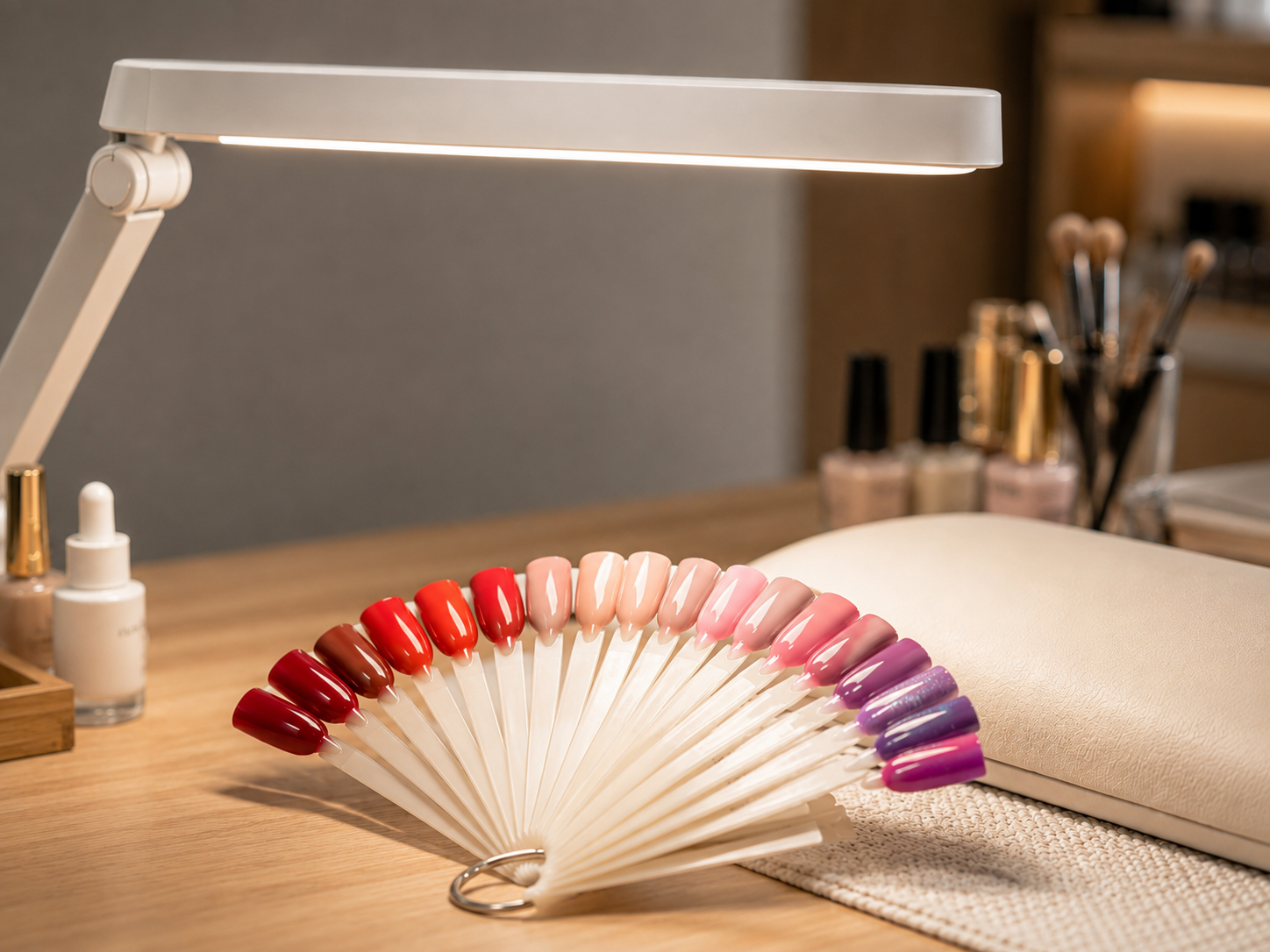
This matters in manicure work because technicians regularly need to distinguish subtle differences between nude shades, reds, pinks, gradients, glitter, chrome finishes, and small design details. Two lamps can have similar brightness but make the same nail color look noticeably different.
As a practical purchasing principle, a higher CRI generally provides better color rendering. For professional beauty work where color judgment is important, CRI should therefore be treated as a meaningful specification rather than a decorative number on a product sheet.
Is CRI 90+ Good for Nail Technicians?
CRI 90+ is a useful benchmark when comparing professional nail lighting because it indicates relatively strong color-rendering performance. Some professional task lights go above CRI 95, which can be particularly relevant when accurate color presentation is a priority.
However, CRI should not be evaluated alone. Light distribution, glare, brightness, lamp position, working distance, and the surrounding room lighting also influence what the technician actually sees at the manicure table.
What Does Color Temperature Mean?
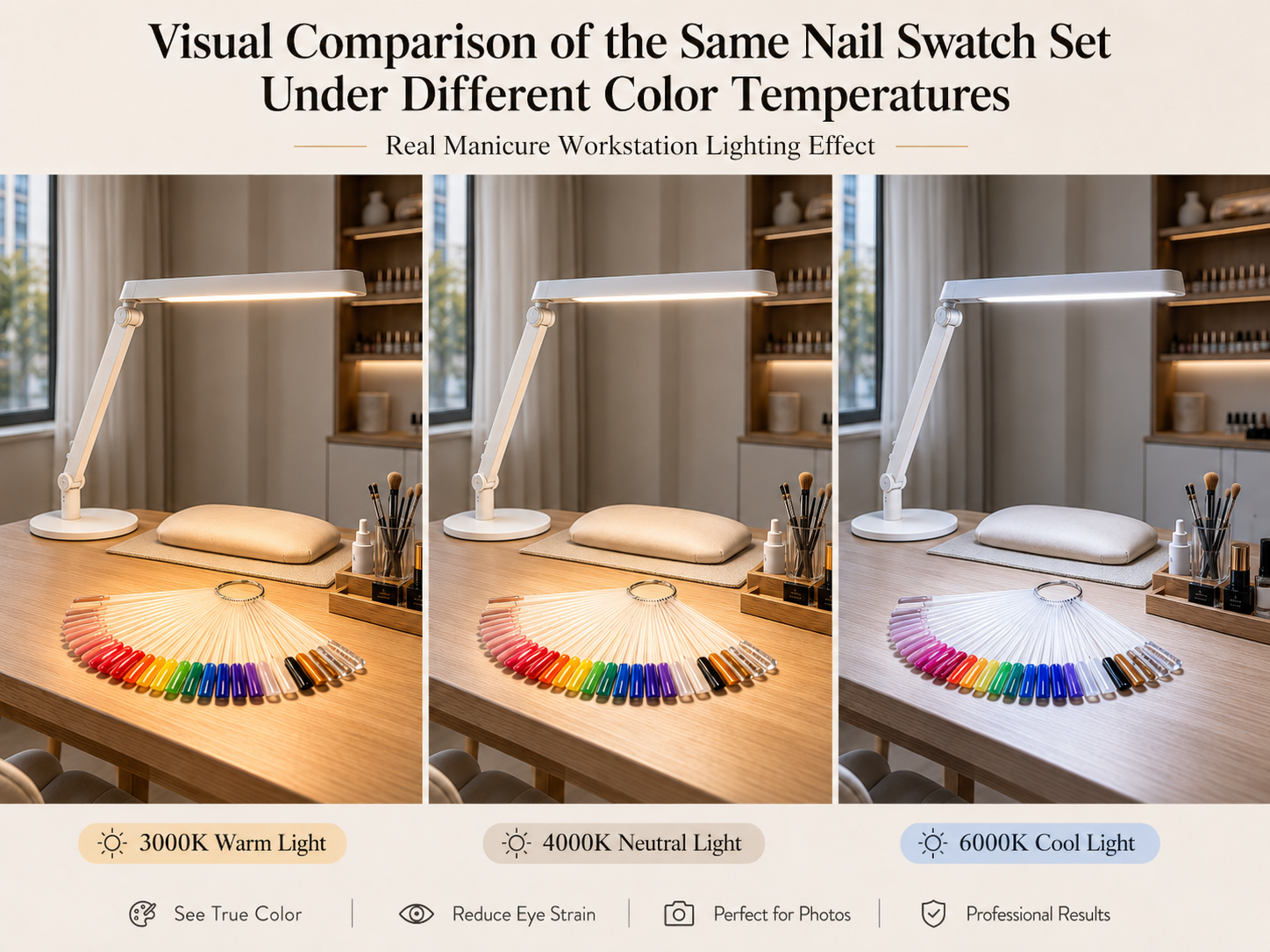
Color temperature is measured in Kelvin (K). Unlike CRI, it does not tell you whether a lamp renders colors accurately. Instead, it describes the visual appearance of the light.
- Around 3000K: warmer, more yellow-toned light.
- Around 4000K–4500K: more neutral-looking light.
- Around 5000K–6500K: cooler, daylight-like white light.
There is no single color temperature that is automatically best for every nail salon. The useful setting depends on the task, room lighting, technician preference, and the visual atmosphere of the salon.
What Color Temperature Is Best for Nail Work?
For detailed manicure work, many professionals prefer neutral-to-cool white light because it can provide a clear-looking working environment. But a salon may also want warmer light for a softer atmosphere when the technician is not performing detail-intensive work.
This is why adjustable color temperature can be more practical than choosing one fixed Kelvin value. A lamp covering several color-temperature settings allows the technician to adapt the workstation as conditions change throughout the day.
For example, some professional nail lamps provide a range from approximately 3000K to 6000K or 6500K. That range can support warmer, neutral, and cooler working-light preferences without requiring several separate lamps.
CRI and Color Temperature Are Not the Same Thing
This distinction is especially important for buyers comparing product specifications.
| Specification | What It Describes | Why It Matters for Nail Work |
|---|---|---|
| CRI | How naturally and accurately colors are rendered | Helps with evaluating polish colors and fine visual details |
| Color temperature | How warm or cool the white light appears | Changes the visual character of the workstation and can suit different tasks or environments |
| Brightness | How much usable light reaches the working area | Affects visibility but does not by itself guarantee accurate color rendering |
A 6000K lamp is therefore not automatically a high-CRI lamp, and a high-CRI lamp does not have to use only cool white light. Buyers should read these specifications separately.
Why Adjustable Lighting Is Useful in a Nail Salon
Nail technicians rarely work under identical conditions all day. Natural daylight changes, salon ambient lighting varies, and different services may require different levels of visual attention.
A lamp with adjustable brightness and color temperature gives the technician more control over the workstation. Cooler settings may be preferred for highly detailed work, while neutral or warmer settings may feel more comfortable in other situations.
Adjustability is also useful for salons that use the manicure station for photos or short-form video. The best setting for performing a service is not necessarily the same setting that works with a smartphone camera or the salon’s ambient lighting.
Why Light Distribution Matters Alongside CRI
A strong CRI specification cannot compensate for poor lamp positioning or uneven illumination.
During a manicure, the technician’s hands, tools, bottles, and the client’s hands can all create shadows. A narrow light source positioned on only one side of the table may leave part of the working area noticeably darker.
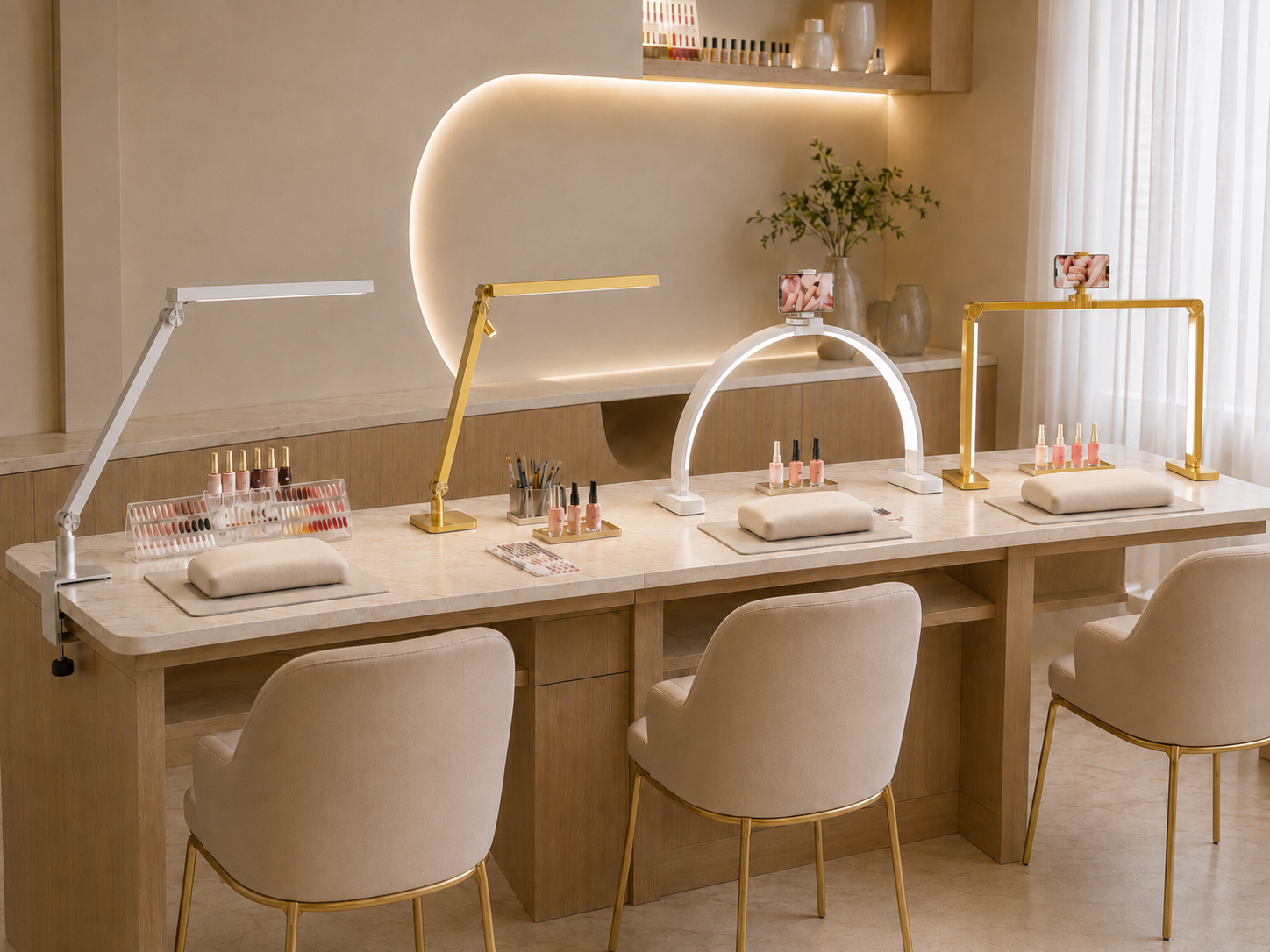
This is one reason wider lamp structures, including half-moon and other extended desk-light designs, are used at professional manicure stations. The goal is to distribute useful light over the working area while keeping the lamp out of the technician’s way.
When planning professional nail salon lighting, buyers should therefore compare light quality and physical coverage together.
How to Compare Nail Lamp Specifications
For a salon owner buying one lamp, specifications help narrow down the options. For a distributor, wholesaler, or private-label brand, the evaluation should go further because the product must work consistently for different end users.
Before choosing a model, compare:
- CRI and the color-rendering requirement of the target customer;
- available color-temperature range;
- brightness adjustment;
- size and distribution of the illuminated area;
- base, clamp, or floor-standing installation;
- adjustment range and structural stability;
- desk space occupied by the lamp;
- controls and ease of adjustment during a service;
- plug and electrical requirements for the destination market;
- packaging and shipping considerations for wholesale orders.
Examples of Different Nail Lighting Configurations
Different manicure stations do not necessarily need the same lighting configuration. A large salon desk, a compact home studio, and a training workstation can have different space and installation requirements.
For example, the half moon nail desk lamp F-800A offers adjustable brightness and a 3000–6500K color-temperature range. Its current specification lists a CRI of ≥85, making it an example of why buyers should read CRI and color temperature as separate specifications rather than assuming a wide color-temperature range also means a particular CRI level.
For buyers who need a clamp-mounted structure, the clamp-mounted nail lamp F-550B currently lists CRI ≥90RA and a 3000–6000K color-temperature range.
Where higher color rendering is a priority, buyers can also compare a high-CRI manicure desk lamp such as LIEQI’s square clamp model, whose current specification lists CRI >95.
These differences are useful for B2B buyers because they make it possible to build a product assortment around different price points, workstation structures, and lighting requirements instead of treating every nail lamp as interchangeable.
What Should B2B Buyers Ask a Nail Lamp Supplier?
Technical specifications are a starting point, but a wholesale or private-label purchase should also consider whether the product is suitable for the intended market.
Before confirming a model, ask the supplier to clarify the CRI specification, color-temperature range, adjustment method, electrical configuration, structure, packaging, and available customization options. When possible, evaluate a sample in a realistic manicure workstation rather than relying only on catalogue images.
A useful sample test is simple: place several difficult-to-distinguish polish shades under the lamp, change the available lighting settings, work at the normal technician distance, and observe both color appearance and shadow coverage. This provides more useful purchasing information than comparing wattage alone.
FAQ: CRI and Color Temperature for Nail Lamps
Is higher CRI always better for a nail lamp?
Higher CRI generally indicates better color-rendering performance, which is valuable for color-sensitive manicure work. However, buyers should also evaluate brightness, glare, light distribution, structure, and the actual workstation environment.
Is 6000K too cool for nail work?
Not necessarily. Some technicians prefer cooler white light for detailed work, while others prefer a more neutral setting. An adjustable lamp gives users more flexibility than a single fixed color temperature.
Does a brighter nail lamp show colors more accurately?
No. Brightness and color rendering describe different properties. A lamp can be bright without having strong color-rendering performance, which is why CRI should be checked separately.
Should nail salons choose adjustable color temperature?
Adjustable color temperature is useful when the same workstation is used under changing ambient light, for different services, or for both manicure work and content creation.
What should wholesalers compare besides CRI?
Wholesale buyers should also compare lighting coverage, color-temperature range, dimming control, structure, stability, installation, electrical specifications, packaging, customization options, and sample-to-bulk consistency.
Choosing the Right Nail Lighting for Your Market
CRI and color temperature are useful purchasing tools when buyers understand what each specification actually means. CRI helps describe color-rendering performance; color temperature describes whether the light appears warm, neutral, or cool. Neither should be judged in isolation.
For salon owners, the right combination can create a clearer and more adaptable workstation. For distributors and private-label brands, understanding these specifications also makes it easier to select products for different customer segments and explain meaningful product differences.
If you are comparing professional nail lamps for wholesale, OEM, ODM, or private-label projects, LIEQI can help you review different structures and lighting specifications based on your target market and application.
Contact LIEQI to discuss nail lighting samples and B2B project requirements.