Choosing an LED magnifying lamp for professional beauty work involves more than selecting the highest advertised magnification. The right lamp should provide a clear viewing area, practical working distance, suitable illumination and a stable structure that fits the treatment environment.
For beauty equipment distributors, salon suppliers and private-label buyers, the decision also involves product configurations, sample evaluation and the needs of different professional users.
This guide explains how to compare LED magnifying lamps for beauty salons, including diopter ratings, lens size, lighting performance, mounting options and the key specifications to confirm before wholesale purchasing.
What Is an LED Magnifying Lamp?
An LED magnifying lamp combines a magnifying lens with an integrated light source. The lens enlarges the appearance of small details, while the surrounding LEDs illuminate the area being examined.
Unlike a standard task lamp, a magnifying lamp provides both optical magnification and localized lighting.
This combination can be useful for beauty professionals performing detailed visual work, including skin observation, brow work, nail detailing and other precision-oriented tasks.
However, not every beauty service requires magnification. Some procedures benefit more from broad, unobstructed lighting than from looking through a lens.
The first step in choosing a magnifying lamp is therefore to determine whether the target user needs magnification, illumination or both.
1. Understand Diopters and Magnification
One of the most confusing specifications in magnifying lamps is the relationship between diopters and magnification.
A diopter is a unit of optical power. It describes how strongly a lens bends light and is related to its focal length.
Magnification, usually expressed as a number followed by “×”, describes how much larger an object appears through the optical system.
These measurements are related, but they are not interchangeable.
3 Diopter vs. 5 Diopter Magnifying Lamps
For conventional illuminated magnifiers, manufacturers commonly use the following approximate magnification values:
| Lens Rating | Approximate Magnification | General Characteristics |
|---|---|---|
| 3 Diopters | 1.75× | Moderate magnification with a relatively generous working distance |
| 5 Diopters | 2.25× | Greater detail enlargement with a shorter working distance |
These values follow a common magnifier convention and should be treated as approximate. Actual viewing results depend on lens design, viewing geometry and the distance between the eye, lens and object.
For professional buyers, the important point is that stronger magnification is not automatically better.
A higher-power lens may enlarge details more, but it can also reduce the area visible through the lens and require the user to work closer to the object.
When comparing products, request both the diopter rating and the stated magnification. If the supplier advertises only a magnification figure, ask how that figure was determined.
2. Consider Working Distance and Field of View
Working distance is the space between the magnifying lens and the object being viewed when the image is in focus.
It is especially important in professional beauty applications because technicians need enough room to position their hands and tools.
A lens that provides strong magnification but leaves very little working clearance may be inconvenient during an actual treatment.
Field of view is equally important. It describes how much of the working area can be observed through the lens at one time.
When comparing magnifying lamps, evaluate three questions together:
- Can the user see the required details clearly?
- Is there enough space to perform the intended task?
- Can the user observe a sufficiently large area without constantly repositioning the lens?
For general observation, a wider field of view may be more practical than maximum magnification.
For very small details, greater magnification may be useful, provided the working distance remains suitable.
There is no universal working distance that fits every professional application. Buyers should test the lamp at the actual workstation height and viewing position.
3. Compare Lens Size and Optical Clarity
Magnification power is only one part of lens performance.
The physical size of the lens affects how comfortably users can observe the working area.
A larger lens can provide a wider usable viewing window, although actual field of view also depends on lens power, optical design and viewing distance.
When evaluating lens quality, consider the following factors:
- Lens diameter and usable viewing area
- Clarity near the center of the lens
- Distortion toward the edges
- Image consistency across the viewing area
- Surface quality and resistance to scratches
- Ease of cleaning and protection during storage
Glass vs. Acrylic Lenses
Magnifying lamps may use glass, acrylic or other optical materials.
Glass lenses can provide good optical clarity and surface durability, while acrylic lenses can reduce weight and may offer advantages in impact resistance.
However, material alone does not determine optical quality. Lens manufacturing, coating, geometry and assembly also affect the final result.
Rather than assuming one material is always superior, buyers should compare actual samples under the same viewing conditions.
Inspect a printed test pattern or another object with fine details through the center and edges of each lens. This can help identify visible distortion or clarity differences.
4. Evaluate the Integrated LED Lighting
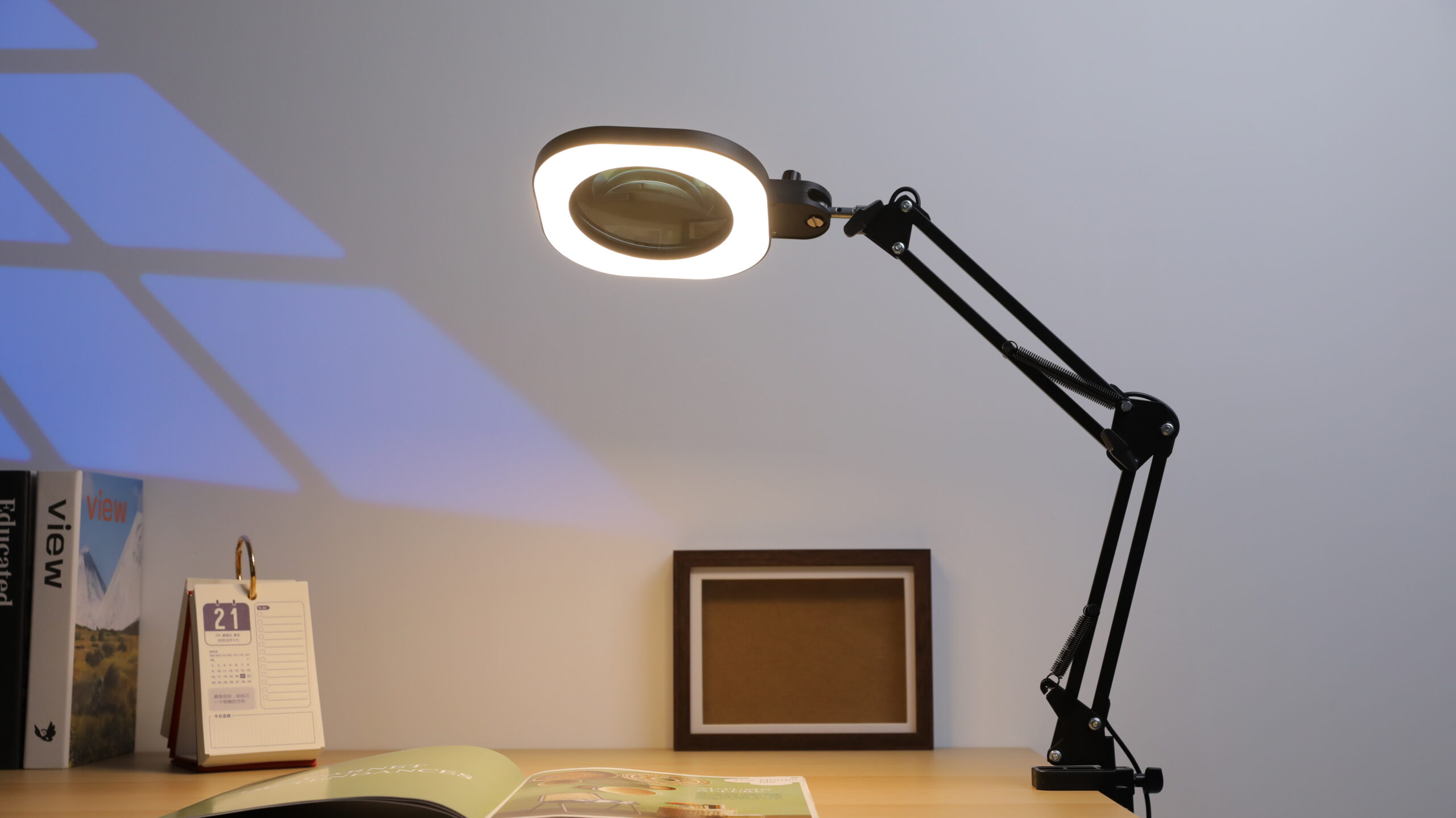
A magnifying lamp should provide useful illumination without creating distracting reflections or glare.
The integrated light source is particularly important because the lens and lamp head are positioned close to the working area.
Buyers should compare several lighting characteristics rather than relying on maximum brightness alone.
Illuminance at the Working Area
Illuminance, measured in lux, describes the amount of light reaching a surface.
This is different from luminous flux, measured in lumens, which describes the total visible light output of a source.
Two lamps with similar lumen ratings may deliver different illuminance at the working surface because of differences in LED arrangement, optical design and working distance.
For a meaningful comparison, ask the supplier to specify the measurement distance when providing lux values.
Color Temperature
Color temperature describes the appearance of white light, from warmer tones to cooler tones.
Adjustable color temperature can be useful in beauty environments where ambient lighting conditions and working preferences vary.
However, the number of available settings is less important than whether the selected settings provide comfortable and useful illumination.
Color Rendering
Color Rendering Index, or CRI, describes how a light source renders colors compared with a reference illuminant.
Color rendering may matter when users need to observe skin tones, product colors or subtle visual details.
Buyers should confirm the stated CRI for the exact product configuration rather than assuming that every lamp from the same supplier has identical color-rendering performance.
Glare and Reflections
Magnifying lenses and glossy surfaces can create reflections when lighting is poorly positioned.
During sample testing, check whether the LEDs remain comfortable to view from the normal working position and whether reflections interfere with observation.
A well-designed lighting arrangement should support visibility without making the lens difficult to use.
5. Choose the Right Mounting Structure
The mounting system influences how a magnifying lamp fits into the working environment.
Professional buyers should consider desk space, treatment-bed layout, adjustment range and the frequency with which the lamp needs to be repositioned.
Desk Clamp Magnifying Lamp
A clamp-mounted lamp attaches to a compatible table or workstation edge.
This structure can help preserve desktop space and is useful where the lamp will remain at a relatively fixed workstation.
Before choosing a clamp configuration, verify the supported desk thickness, mounting stability and available clearance around the table edge.
Desktop Base Magnifying Lamp
A desktop base allows the lamp to stand independently without requiring a suitable clamp location.
This can make installation more flexible, although the base occupies part of the working surface.
Buyers should compare the base footprint, stability and available arm reach.
Floor-Standing Magnifying Lamp
A floor-standing structure can be useful around treatment beds or workstations where desktop mounting is inconvenient.
Depending on the design, a floor lamp may include adjustable height, a mobile base or casters for repositioning.
When evaluating this configuration, check stability, floor-space requirements and movement around nearby furniture.
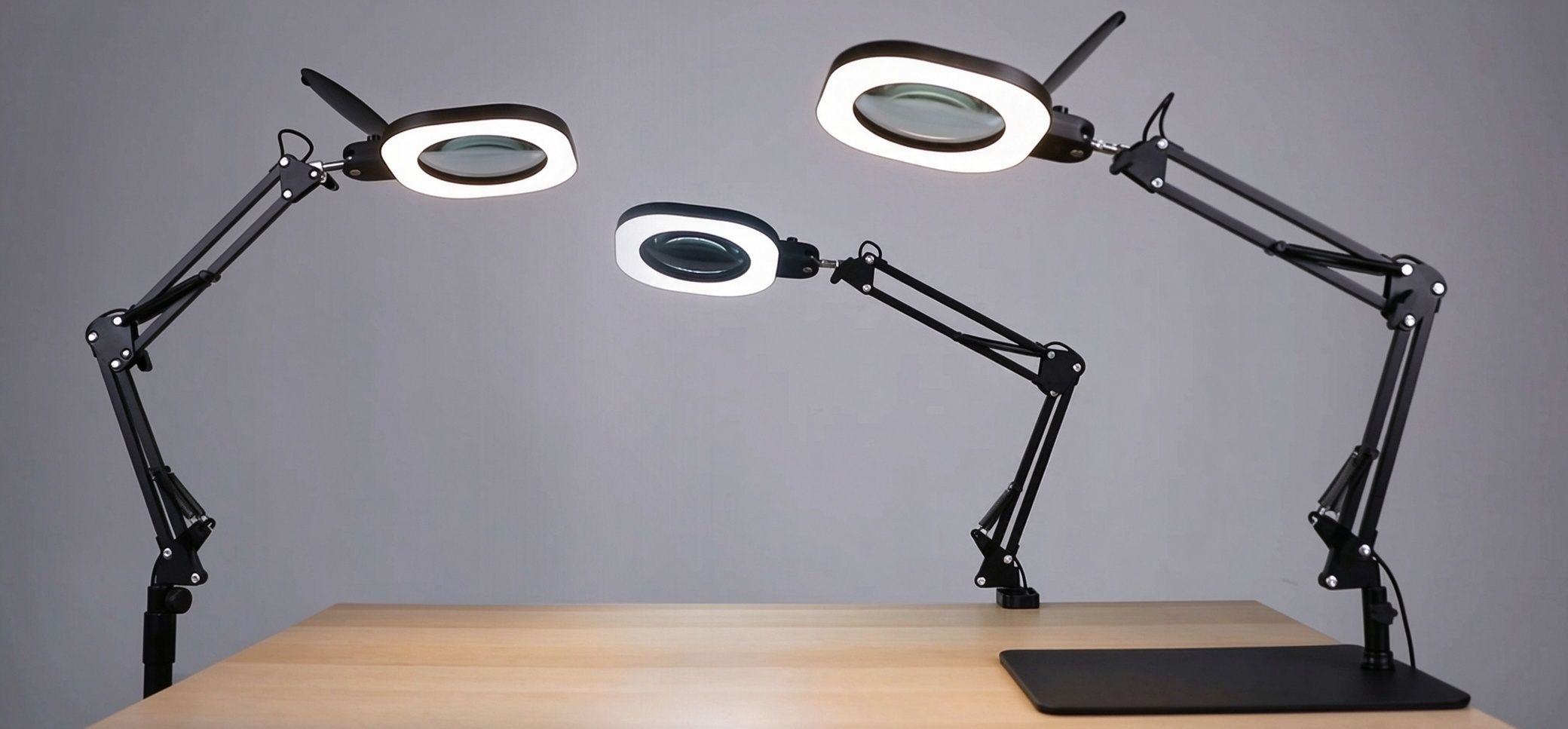
For example, LIEQI’s LED magnifying lamp with adjustable arm is presented with different mounting configurations, including desk clamp, desktop and floor-standing options.
The purchasing principle is to match the structure to the intended workspace rather than selecting a mounting type based only on appearance.
6. Check Arm Adjustment and Structural Stability
A magnifying lamp must remain stable after the user positions the lens.
This requirement becomes especially important when the lamp head is relatively heavy or the arm is extended away from its mounting point.
During sample evaluation, move the lamp through its normal adjustment range several times.
Check whether the joints hold their position, whether the head can be tilted without drifting and whether the arm can reach the intended viewing area.
Also consider how easily the user can move the lens away when magnification is no longer required.
A lamp that provides clear magnification but is difficult to reposition may interrupt the normal workflow.
7. Consider Lens Protection and Daily Maintenance
Professional beauty environments may expose equipment to dust, airborne particles and frequent handling.
For a magnifying lamp, keeping the lens clean is particularly important because dust, fingerprints and scratches can reduce viewing clarity.
A protective lens cover can help reduce exposure when the lamp is not in use.
Buyers should also check whether the cover is easy to operate and whether it remains secure during normal handling.
For cleaning, follow the manufacturer’s instructions for the specific lens material and surface finish.
Do not assume that alcohol, acetone or other salon chemicals are suitable for every lens or coating.
If chemical resistance is important for the intended market, request the relevant cleaning guidance or material compatibility information from the supplier.
8. Match the Lamp to the Professional Application
Different beauty services place different demands on magnification, illumination and positioning.
A buyer selecting products for multiple customer groups should avoid treating every magnifying lamp as interchangeable.
| Application | Key Evaluation Priorities |
|---|---|
| Esthetician Workstations | Clear viewing area, adjustable lighting, lens positioning and treatment-bed access |
| Brow and Detail Work | Suitable magnification, working clearance and stable adjustment |
| Nail Detail Inspection | Optical clarity, desk-space efficiency and flexible positioning |
| Beauty Training | Ease of adjustment, practical viewing distance and repeated-use durability |
| General Precision Work | Lens clarity, lighting performance and mounting compatibility |
These are evaluation priorities rather than fixed prescriptions. Individual professionals may prefer different magnification levels or working arrangements.
For applications where magnification is unnecessary, buyers may also compare professional LED desk lighting options that provide task illumination without an integrated lens.
9. What B2B Buyers Should Check Before Ordering Samples
For wholesalers, distributors and private-label brands, a magnifying lamp should be evaluated as a complete commercial product.
In addition to the lens and lighting performance, buyers should confirm the configuration, included accessories and documentation.
A practical sample-evaluation checklist includes:
- Confirmed magnification and diopter specifications
- Lens diameter and material
- Practical working distance
- Optical clarity and edge distortion
- Brightness and color-temperature controls
- Electrical input and adapter configuration
- Arm reach and adjustment stability
- Clamp, desktop base or floor-stand compatibility
- Lens cover and cleaning instructions
- Assembly instructions and included accessories
- Packaging protection during transportation
- Applicable compliance documentation for the target market
Where possible, test the sample in a realistic workstation instead of evaluating it only from product photographs or a specification sheet.
Record the results and communicate any required changes before approving the final configuration.
10. Questions to Ask an LED Magnifying Lamp Supplier
When sourcing magnifying lamps for wholesale distribution or private-label projects, clear technical communication helps reduce misunderstandings.
Before requesting a quotation, prepare the following information:
- Target application and customer group
- Preferred magnification or diopter range
- Required lens diameter and material
- Mounting configuration
- Lighting and control requirements
- Destination market and electrical requirements
- Preferred product color and finish
- Branding and packaging requirements
- Estimated order quantity
Ask the supplier to identify which requirements are already available in standard configurations and which would require additional development or customization.
For OEM and ODM projects, document any changes to the product’s appearance, function, mounting system, packaging or branding.
These details can form the basis of a clearer discussion about custom lighting requirements.
11. Verify Compliance for the Destination Market
Electrical products may be subject to different requirements depending on the destination country, product design, power supply and intended use.
Before placing a wholesale order, buyers should confirm which regulations and standards apply to the exact configuration being purchased.
Do not assume that a certification associated with one model automatically covers every version, adapter or customized configuration.
Where compliance documentation is required, request the relevant test reports, declarations or certificates and verify their applicability to the product and market.
For products intended for specialized professional or regulated applications, additional requirements may apply depending on their claims and intended use.
FAQ: LED Magnifying Lamps for Beauty Professionals
What is the difference between a 3-diopter and 5-diopter magnifying lamp?
Under a common magnifier convention, a 3-diopter lens provides approximately 1.75× magnification, while a 5-diopter lens provides approximately 2.25×. A higher-power lens generally offers greater enlargement but a shorter working distance. Actual results depend on the optical design and viewing conditions.
Is higher magnification always better for beauty work?
No. Higher magnification can reduce the usable viewing area and working clearance. The appropriate level depends on the task, viewing distance and the user’s working preferences.
What lens size should I choose for an esthetician magnifying lamp?
Choose a lens that provides a comfortable viewing area for the intended treatment. Lens diameter should be considered together with magnification, working distance and optical clarity rather than evaluated separately.
Should I choose a desk clamp or floor-standing magnifying lamp?
A desk clamp can preserve working space at a fixed workstation, while a floor-standing configuration may offer more positioning flexibility around treatment beds. The better choice depends on the available space and normal workflow.
What should wholesalers confirm before ordering LED magnifying lamps?
Confirm optical specifications, lighting performance, mounting options, electrical requirements, included accessories, packaging and applicable compliance documentation. Physical sample evaluation is recommended before approving a new bulk-order configuration.
Choose Magnification, Lighting and Structure Together
A professional LED magnifying lamp should provide more than an impressive magnification number.
The most suitable product combines useful optical performance, comfortable working distance, appropriate illumination and a structure that fits the intended workspace.
For B2B buyers, comparing these factors together makes it easier to identify the right configuration and communicate product requirements clearly before ordering.
If you are sourcing LED magnifying lamps for salon equipment distribution, wholesale supply or a private-label project, contact LIEQI to discuss available product configurations, samples and customization requirements.